
Personal Info
Known For
Gender
Birthday
Place of Birth
Leni Riefenstahl
Biography
Known for

aspekte
A 30-minute weekly cultural magazine program. The head of aspekte, Wolgang Herles, describes the program as follows: "For 40 years, "aspekte" has repeatedly set out to enrich television with cultural contrasts. "aspekte" understands culture not as the sum of facts and events, but as the taste, the sound, the rhythms of the times. It has proven itself as a journal of true luxury and fashions as well as an instrument of public education and information."
Je später der Abend

The Holy Mountain
In the mountains, Diotima meets Karl and fall in love and have an affair. Karl's friend Vigo mistakenly believes she's in love with him, causing rifts in all relationships.
Das ist Ihr Leben

Riefenstahl
Explores Leni Riefenstahl's artistic legacy and her complex ties to the Nazi regime, juxtaposing her self-portrayal with evidence suggesting awareness of the regime's atrocities.

The Blue Light
Junta is hated by the people in the village where she lives, especially by the women, who suspect her of being a witch. Only she can climb the nearby mountains to a cave high up, whence a mysterious blue light glows when the moon is full. Many young men of the village have died trying to follow her. She is driven out of town, and takes to living in the mountains. Eventually she shares the secret of the blue light with one man, and he betrays it.

The Goebbels Experiment
The Nazi propaganda mastermind behind Hitler speaks in first person as actor Kenneth Branagh reads pages of the diary kept by the chief of propaganda, Joseph Goebbels, revealing the man's most inner thoughts.

Faszination Bergfilm - Himmelhoch und Abgrundtief
A fascinating chronology of 100 years of mountain film history in the Alps. This documentary focuses primarily on films shot on the Matterhorn, the Eiger, and the Grandes Jorasses, considered until the 1930s as the "last problems of the Alps," and shows the evolution of mountain filmmaking through numerous excerpts from documentaries and feature films – notably on the Matterhorn in 1901. The genre, appropriated as a means of mass exaltation by "fascist" regimes during the Second World War, was reinvented in the 1950s by Gaston Rebuffat, Marcel Ichac, and Lionel Terray in the Mont Blanc massif, avant-garde figures of French mountain cinema, who reintroduced, beyond performance, the values of the mountains – and in color – poetry, humor, and sharing among people from all walks of life.

Olympia Part One: Festival of the Nations
Starting with a long and lyrical overture, evoking the origins of the Olympic Games in ancient Greece, Riefenstahl covers twenty-one athletic events in the first half of this two-part love letter to the human body and spirit, culminating with the marathon, where Jesse Owens became the first track and field athlete to win four gold medals in a single Olympics.
Biographies
A weekly sit-down with Hermann Schreiber and Peter W. Jansen with a figure of German cinema.
LENI
The play is an atypical story about Leni Riefenstahl, Adolf Hitler's court director, one of the best filmmakers in the world, who rose to fame thanks to films commissioned by the Third Reich. The character of Leni was portrayed by Zdena Studénková in the drama of the Slovak National Theatre. The original Slovak play Leni by Valerie Schulczová and Roman Olekšák is about a fictional meeting of two real people. The legendary presenter Johnny Carson, whose "The Tonight Show Starring Johnny Carson" was one of the most watched talk shows in America for thirty years, and the controversial Leni Riefenstahl, Adolf Hitler's "court director". It's 1974, Johnny is at the height of his career, and Leni is in America presenting her first completed project since the defeat of Germany - a book of photographs from Africa - Last of Nubu. But Johnny knows what his audience is more interested in than art.
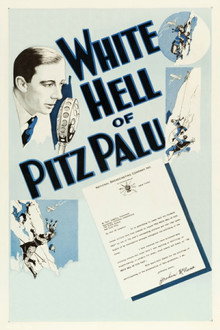
The White Hell of Pitz Palu
Dr. Johannes Krafft climbs a 12,000-foot mountain over and over again to search for his wife, who was lost on their honeymoon. Another couple makes the dangerous climb with him.
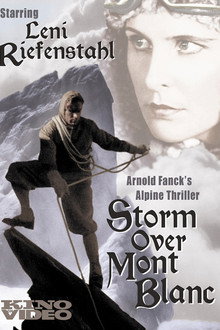
Storm Over Mont Blanc
Hannes is employed at the Mont Blanc Observatory; the only outside connection is a pilot and Hella over the radio. Hella ascends the mountain but her father dies along the way.

The Wonderful Horrible Life of Leni Riefenstahl
This documentary recounts the life and work of one of most famous, and yet reviled, German film directors in history, Leni Riefenstahl. The film recounts the rise of her career from a dancer, to a movie actor to the most important film director in Nazi Germany who directed such famous propaganda films as Triumph of the Will and Olympiad. The film also explores her later activities after Nazi Germany's defeat in 1945 and her disgrace for being so associated with it which includes her amazingly active life over the age of 90.

FASCISM(s): A Film in Six Parts
Six sequences about Fascism and its segments throughout history.