Personal Info
Known For
Gender
Birthday
Place of Birth
Arnold Marlé
Known for
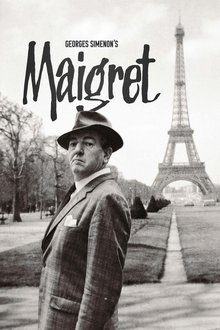
Maigret
BBC series based on the novels by Georges Simenon which starred Rupert Davies as Inspector Maigret, a French police detective who preferred to watch and listen in order to solve crimes. The series ran from 1960-63 on British television.

Espionage
Pulled from actual case histories and utilizing newsreel and documented narratives, the activities of spies from various countries are depicted as far back as the American Revolution and as recent as the Cold War.

Zarak
A notorious bandit develops a grudging respect for the English military man assigned to capture him.
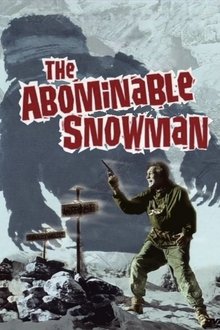
The Abominable Snowman
A kindly English botanist and a gruff American promoter lead an expedition to the Himalayas in search of the legendary Yeti.

The Creature
A scientist searches for the Yeti in a Himalayan fastness, and is soon at odds with an adventurer who wants to find the Creature for less exalted reasons.

The Man Who Could Cheat Death
Dr. Bonner plans to live forever through periodic gland transplants from younger, healthier human victims. Bonner looks about 40; he's really 104 years old. But people are starting to get suspicious, and he may not make 200.

One of Our Aircraft Is Missing
During a raid on Germany, a British bomber crew is forced to bail out after their plane is damaged. They land in Holland, where they're aided by Dutch civilians.

The Naked Truth
Nigel Dennis publishes a scandal magazine. But for each story he writes, he first approaches the person whose scandalous behavior is described (or rather implied, to avoid any libel suit) and says he will suppress the story in return for money. Several of his victims first decide individually to kill him instead of paying, but fail in amusing ways. Then they find that to protect their various secrets they must now join forces for a rather different purpose...

Break in the Circle
An adventurer is hired by a German millionaire to help a Polish scientist escape to the West.
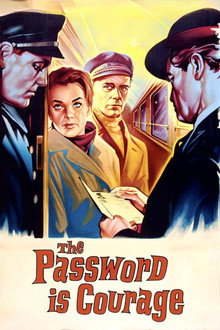
The Password Is Courage
Sergeant-Major Charles Coward, a brave British soldier is captured by German forces during World War II. When he's thrown into a prisoner of war camp, he immediately plans his escape. Masquerading as a wounded German soldier, he makes it as far as the medical tent, where the deceived enemy forces award him the Iron Cross. Though he is ultimately discovered, he goes on to courageously pursue his freedom with a whimsical and undying audacity.
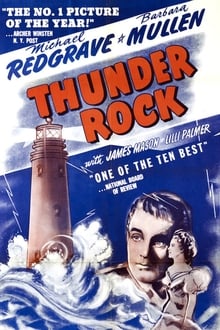
Thunder Rock
David Charleston, once a world renowned journalist, now lives alone maintaining the Thunder Rock lighthouse in Lake Michigan. He doesn't cash his paychecks and has no contact other than the monthly inspector's visit. When alone, he imagines conversations with those who died when a 19th century packet ship with some 60 passengers sank. He imagines their lives, their problems, their fears and their hopes. In one of these conversations, he recalls his own efforts in the 1930s when he desperately tried to convince first his editors, and later the public, of the dangers of fascism and the inevitability of war. Few would listen. One of the passengers, a spinster, tells her story of seeking independence from a world dominated by men. There's also the case of a doctor who is banished for using unacceptable methods. David has given up on life, but the imaginary passengers give him hope for the future.

They Can't Hang Me
A murderer hopes to escape his death sentence by identifying the leaders of a spy ring.
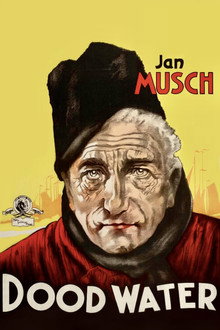
Dead Water
After building a dam, closing off the Zuiderzee from the sea, it effectively turns the former sea into a lake and the fishermen call it "dead water". They desperately attack the dam with spades and even explosives, culminating in tragedy.

The Glass Mountain
An aspiring composer, in the British Air Force for WWII, is downed in Italy and rescued by an Italian girl. He returns home to his wife, inspired to write an opera and aware that he's fallen in love with his rescuer.

Mr. Emmanuel
An elderly Jewish man from Manchester, travels to Nazi Germany to seek the mother of a young German refugee that has attempted suicide. In Germany, Mr. Emmanuel’s efforts to seek out Hertha Rosenhein are greeted by a wall of silence from the scared Jewish community and anti-Semitic hatred from many Germans.