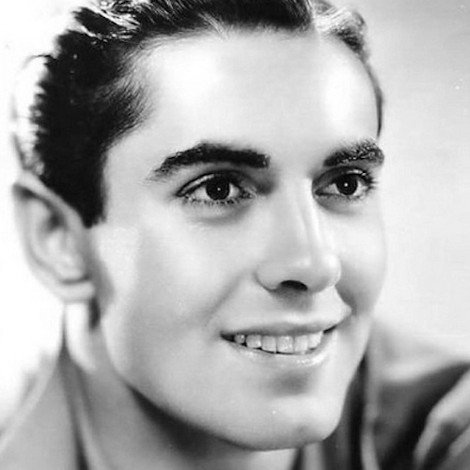
Personal Info
Known For
Gender
Birthday
Place of Birth
Tyrone Power
Biography
Known for

What's My Line?
Four panelists must determine guests' occupations - and, in the case of famous guests, while blindfolded, their identity - by asking only "yes" or "no" questions.

Bambi
The Bambi, often called the Bambi Award and stylised as BAMBI, is a German award presented annually by Hubert Burda Media to recognize excellence in international media and television to personalities in the media, arts, culture, sports, and other fields "with vision and creativity who affected and inspired the German public that year", both domestic and foreign. First held in 1948, it is the oldest media award in Germany. The trophy is named after Felix Salten's book Bambi, A Life in the Woods and its statuettes are in the shape of the novel's titular fawn character. They were originally made of porcelain until 1958, when the organizers switched to using gold, with the casting done by the art casting workshop of Ernst Strassacker in Süßen.

The Ed Sullivan Show
The Ed Sullivan Show is an American TV variety show that originally ran on CBS from Sunday June 20, 1948 to Sunday June 6, 1971, and was hosted by New York entertainment columnist Ed Sullivan. It was replaced in September 1971 by the CBS Sunday Night Movie, which ran only one season and was eventually replaced by other shows. In 2002, The Ed Sullivan Show was ranked #15 on TV Guide's 50 Greatest TV Shows of All Time.

Cinépanorama

The Oscars
An annual American awards ceremony honoring cinematic achievements in the film industry. The various category winners are awarded a copy of a statuette, officially the Academy Award of Merit, that is better known by its nickname Oscar.

Witness for the Prosecution
An ailing barrister is thrust back into the courtroom in what becomes one of the most unusual and eventful murder cases of the lawyer's career when he finds himself defending a man being tried for the murder of a socialite.

Nightmare Alley
A roustabout joins a traveling carny and schemes to figure out the mind-reading act of Mademoiselle Zeena and her alcoholic husband.

The Black Swan
When notorious pirate Henry Morgan is made governor of Jamaica, he enlists the help of some of his former partners in ridding the Caribbean of buccaneers. When one of them apparently abducts the previous governor's pretty daughter and joins up with the rebels, things are set for a fight.

Armchair Theatre
Armchair Theatre is a British television drama anthology series of single plays that ran on the ITV network from 1956 to 1974. It was originally produced by Associated British Corporation, and later by Thames Television from mid-1968.

Brigham Young
Based on the story of the famous Mormon leader, it follows Brigham Young and his challenge to transport his people across the Rocky mountains to settle in Salt Lake City. The plot focuses on two fictitious characters, Jonathan Kent and Zina Webb and the hardships they have to face along the way.

In Old Chicago
The O'Leary brothers -- honest Jack and roguish Dion -- become powerful figures, and eventually rivals, in Chicago on the eve of its Great Fire.

The Mark of Zorro
Returning from Spain, the son of a California nobleman comes home to find his native land under a villainous dictatorship. On one hand, he plays the useless fop, while on the other, he is the masked avenger Zorro.

Lusitanian Illusion
Images and sounds expose the duality of Portugal during the days of WW2: a peaceful, god-loving, rural country, providing an escape route for over one hundred thousand European refugees to the Americas; and a political and cultural elite that disguised their Nazi inclinations just enough to play its neutral role in international politics.

The Sun Also Rises
A group of disillusioned American expatriate writers live a dissolute, hedonistic lifestyle in 1920's France and Spain.

Gay, Gay Hollywood
The short shows various clips from Hollywood feature films that, like the title of the film, are full of double entendre. It includes a segment from a Little Rascals short, a performance by Glen Campbell (who ironically was a well-known homophobe), and a segment from a Gene Autry singing cowboy western, as well as a Jerry Lewis bit with Jerry in drag.