Shoes

Personal Info

Known For

Acting

Gender

Male

Birthday

1903-01-01

Place of Birth

Limassol, Republic of Cyprus

Thodoros Moridis

Biography

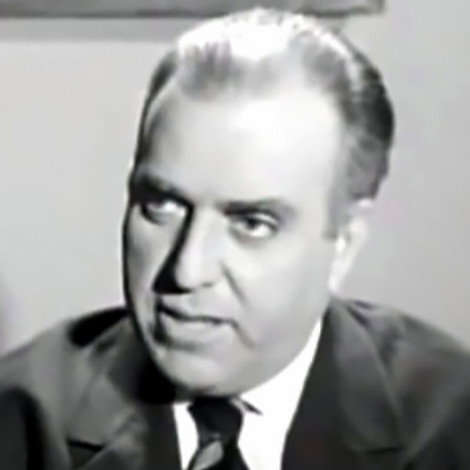
Thodoros Moridis (Greek: Θόδωρος Μορίδης, Limassol, 1905 – Athens, 22 December 2003) was a Greek Cypriot actor. Born in the city of Limassol in Cyprus, Thodoros Moridis made his debut in 1924 with the Emilios Veakis - Christopher Nezer troupe in the play For Her Love. With them, he also co-starred in Sophocles' Oedipus Tyrannus, among others. With the Cybele troupe, he played in Agnosto (1927) and the following year in Iphigenia en Tavroiis with Eleni Chalkousi, with whom he collaborated again in Bogris's The Engagement. He was a key figure in Vasilis Rotas' "People's Theatre" and in 1932 he collaborated for the first time with Marika Kotopouli - he later continued in her theatre which also housed the "Karolos Koun" Art Theatre, while in 1936 he began his collaboration with Mrs. Katerina, in whose troupe he remained until 1943, performing many important roles in major works of world drama (The Lady with the Camellias, The Merchant of Venice, Much Ado About Nothing, Enda Gambler, Pygmalion, The Lady of the Sea, Nora, etc.). In Katerina's troupe he met and loved Jolie Garbi and married her, with whom he was together for 60 years on stage and in life. This was followed by collaborations with the Manolidou - Veakis - Pappas troupe (1943-44) (The Shepherdess' Lover), with the "United Artists" (1945-46) (Julius Caesar, Enemies of Maxim Gorky, The Brothers Karamazov, Von Dimitrakis, etc.), with the "Thymelikos Troupe", with Mimis Fotopoulos, with Nikos Hadziskos, where he performed Polonius in Hamlet (1955), with the "Hellenic People's Theatre" of Manos Katrakis (Christ Recrucified, The Idiot, Queen Amalia), with Antigone Valakou, Mary Aroni (Manto Mavrogenous), with Elsa Vergi. From 1961 to 1983 he joined the National Theatre, performing dozens of important roles in ancient drama and in the world drama (Aias, Agamemnon, Trojans, Philoctetes, Medea, Rosmersholm, The King, The Demoniac, The Tempest, The Cherry Orchard, Mary Stuart, General Secretary, etc.). Immediately afterwards he participated in Master Solnes, Dimitris Horn's last performance. This was followed by The Strange Intermezzo with Alexandrakis - Galineus, Oedipus at Colonus with the "Empirical Troupe" of Minotis, collaborations with Danis Katranidis, Marietta Rialdi, George Messalas. In cinema he participated in many films from 1948 to the 1970s (Lost Angels, Red Rock, The Duchess of Placentia, Golfo, Heartbeats at the Desk, Zousa the Monk Without Love, Electra - a filmed performance from Epidaurus in 1961 directed by Takis Mouzenidis with Anna Synodinou, etc.), as well as in television (Police Stories, The Garden with Statues, etc.). He died on December 22, 2003, at the age of 98. He died at the Attiko Hospital where he was hospitalized and became known in the media on January 2, 2004. He was the husband of actress Tzolys Garbi. She was buried in Marathon, as had happened with Jolie Garbi.

Known for

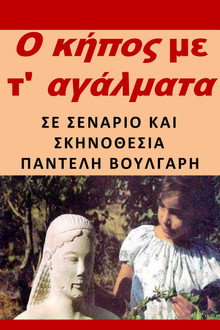
The garden with the statues
The garden with the statues

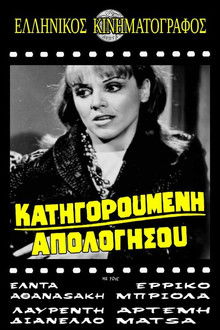
Κατηγορούμενη απολογήσου
Κατηγορούμενη απολογήσου

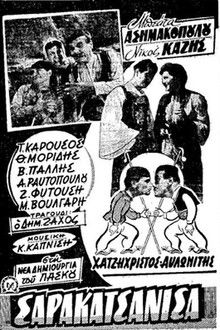
Sarakatsanissa

Sarakatsanissa

The story of Romeo and Juliet is transferred to the Greek province (on the slopes of Mount Parnassos), where the conflict between two powerful Sarakatsanai families rages, whose children, despite family hatreds, love each other madly.
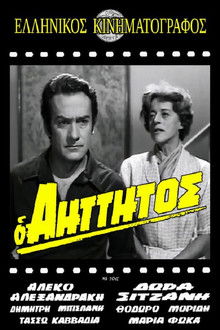
Ο αήττητος

Ο αήττητος

A childless Romani woman abducts the daughter of the prosecutor who imprisoned her. As she trains the child to do her evil bidding, the girl becomes a woman and soon finds herself accused of murder. Can a trainee solicitor clear her name?
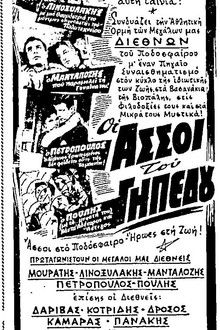
Experts on the Football Field

Experts on the Football Field

The everyday lives of some international football players before and after a big game.
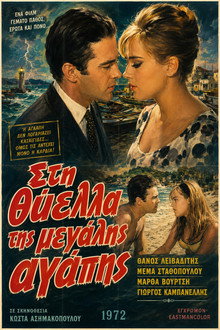
Στη θύελλα της μεγάλης αγάπης
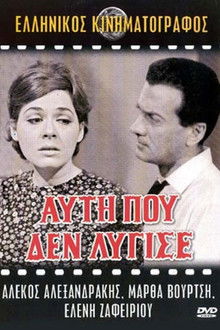
Στη θύελλα της μεγάλης αγάπης

The one that didn't bend

The one that didn't bend

Δρόσω η αρχοντοπούλα
Δρόσω η αρχοντοπούλα

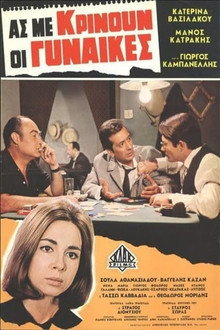
Ας με κρίνουν οι γυναίκες

Ας με κρίνουν οι γυναίκες

Return from the front

Return from the front

Madalena

Madalena

Madalena is a tough seventeen-year-old who is forced to take on her father's ferry business after he dies. She has her many brothers and sisters to support, and there is no one else to do the job. So she rallies her defenses and sets out to give her rival in the ferry business a run for his money. But at the same time, the rival's handsome son is starting to look better and better. Madalena refuses to acknowledge her feelings for him -- though how long she can sustain that denial is the question.

The Cry of an Innocent

The Cry of an Innocent

A former teacher, Alexis Vergis, agrees to give private lessons to the young son of a wealthy family, but quickly realizes that the real reason he was hired is to help Anna, the boy's sister, who has suffered a nervous breakdown after the death of her fiancé. With kindness and methodicalness, he tries to lift the girl's spirits. Walks in the countryside and conversations about happy and carefree topics help her to relax somewhat. However, Anna's stepmother is disturbed by the relationship developing between the two young people, because she actually intends to have Anna committed to a mental institution and inherit her husband's fortune. She tries to slander Alexis and partly succeeds, but in the end, the truth shines through and the love of the two young people triumphs.
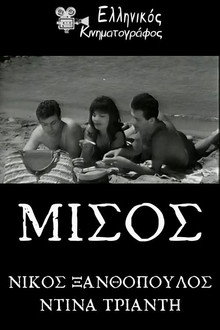
Μίσος
Μίσος

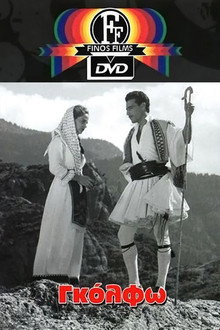
Golfo-Girl of the Mountains

Golfo-Girl of the Mountains

Spiridon Peresiadis (1864 - 1918) was one of the best writers of the dramatic idylls and mountain adventure genre that flourished into the late nineteenth century in Greece. In 1894, Peresiadis wrote Golfo, a story of love, jealousy and betrayal. In a village near Mount Helmos where the waters of the River Styx of Mavroneri flow, the young Golfo and Tassos swear eternal love to one another. True to her word, Golfo rejects a nobleman who wishes to marry her, but Tassos breaks his oath and agrees to wed a rich young woman instead. When he changes his mind, it is too late and the forces of destiny continue to their inevitable conclusion
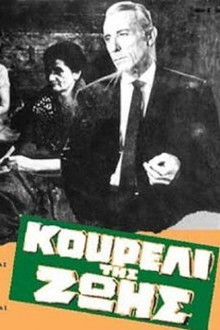
Rag of life

Rag of life

After the end of World War II, a Greek woman who was imprisoned in a German concentration camp returns to Greece. She is a woman broken by the hardships, but at the same time determined to find the man who caused her all this misery, namely the one who reported her to the Gestapo as a Jew.