
Personal Info
Known For
Gender
Birthday
Place of Birth
Felipe Levy
Known for

The Trapalhões
Os Trapalhões was a Brazilian comedy group and also a Brazilian television series created by Wilton Franco. Its members were Dedé Santana, Zacarias, Mussum and their leader Didi Mocó, that was played by Renato Aragão. The name Trapalhões is derived from the Portuguese verb atrapalhar, which means the opposite of helping, to do something the wrong way or to Those that confuse. The name is translated "Tramps" in English DVD subtitles. It was aired by Rede Globo from 1977 to 1999. On March 18, 1990, Zacarias died due to respiratory failure, but the group and the series didn't come to an end until July 29, 1994, when Mussum died due to an unsuccessful heart transplant.

Os Imigrantes
In Europe, at the end of the 19th century, social policies sent thousands of immigrants out of their countries. A Spaniard, a Portuguese, and an Italian seek new opportunities in the new country, without imagining the difficulties along the way.

O Machão
Nino, o Italianinho

Balança Mas Não Cai
A Fábrica

Vitória Bonelli

Cara a Cara
Millionaire Ingrid Von Herbert comes to Brazil to search for her missing son, who was taken from her in Italy by the child's father during World War II. Here, she meets and falls in love with mechanic Fran, but resists this love because she suspects he might be her son. There are other suspicions, but this mystery persists throughout the plot. An unusual event changes the course of the story: Fran's father, Sandro, has his car sabotaged and dies in an accident.
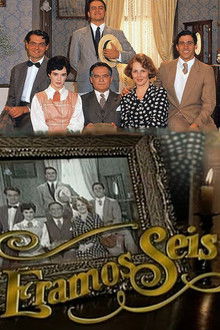
Éramos Seis
Éramos Seis is a Brazilian period drama telenovela produced by SBT and originally broadcast from May 9 to December 5, 1994. Based on the 1943 novel of the same name by Maria José Dupré, it was adapted by Sílvio de Abreu and Rubens Ewald Filho, with direction by Henrique Martins and Del Rangel and general direction by Nilton Travesso. The telenovela stars Irene Ravache, Othon Bastos, Jandir Ferrari, Tarcísio Filho, Luciana Braga, and Leonardo Brício. Set in São Paulo between the 1920s and 1940s, the story follows Dona Lola, a devoted wife and mother who struggles to keep her family together despite financial hardship and personal tragedy. As her four children—Carlos, Alfredo, Isabel, and Julinho—grow into adulthood, each follows a different path shaped by love, ambition, and loss. Through decades of sacrifice and resilience, Lola witnesses the joys and sorrows of family life while enduring profound changes that ultimately leave her to reflect on a lifetime of devotion.

As Pupilas do Senhor Reitor
As Pupilas do Senhor Reitor is a Brazilian telenovela produced by SBT and originally broadcast from December 6, 1994, to July 8, 1995. Based on the 1867 novel of the same name by Portuguese writer Júlio Dinis, it was adapted by Lauro César Muniz, with scripts by Bosco Brasil, Ismael Fernandes, Analy A. Pinto, Aziz Bajur, and Zeno Wilde under the supervision of Chico de Assis. The telenovela stars Juca de Oliveira, Débora Bloch, Luciana Braga, Eduardo Moscovis, and Tuca Andrada. Set in a 19th-century Portuguese village, the story follows the orphaned sisters Guida and Clara, who are raised by the respected Padre Antônio, known as the Senhor Reitor. After Daniel returns home as a doctor following years away, old feelings are rekindled, but misunderstandings, forbidden love, family rivalries, and social expectations threaten the happiness of both sisters. As secrets and sacrifices come to light, the couples must overcome prejudice and scandal in their search for true love.
Xeque-Mate
Meu Rico Português

Os Ossos do Barão
Os Ossos do Barão is a Brazilian telenovela produced by SBT and originally broadcast from April 28 to September 8, 1997. It is an adaptation of Jorge Andrade's 1963 play of the same name, adapted for television by Walter George Durst, with collaboration from Duca Rachid, Mário Teixeira, and Marcos Lazarini. The telenovela stars Ana Paula Arósio, Tarcísio Filho, Juca de Oliveira, Othon Bastos, and Leonardo Villar. Set in São Paulo in 1948, the story follows Egisto Ghirotto, the wealthy son of Italian immigrants who dreams of gaining social prestige by marrying his son, Martino, to Isabel, the great-granddaughter of the late Baron of Jaraguá. Their romance sparks a bitter conflict between a rising immigrant family and a declining aristocratic dynasty, exposing themes of class, ambition, tradition, and the social transformation of Brazil.