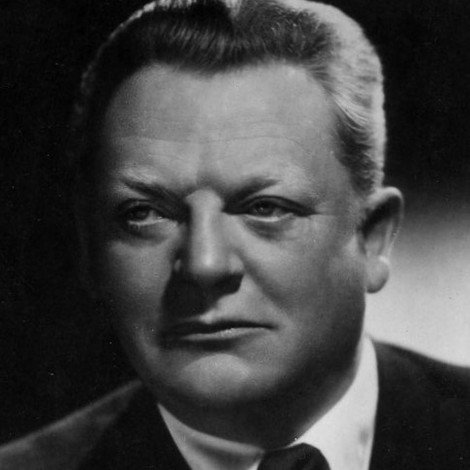
Personal Info
Known For
Gender
Birthday
Place of Birth
Otto Wernicke
Biography
Known for

M
In this classic German thriller, Hans Beckert, a serial killer who preys on children, becomes the focus of a massive Berlin police manhunt. Beckert's heinous crimes are so repellant and disruptive to city life that he is even targeted by others in the seedy underworld network. With both cops and criminals in pursuit, the murderer soon realizes that people are on his trail, sending him into a tense, panicked attempt to escape justice.

Maria Ilona
In 1848, the freedom-loving Hungarian people, led by Ludwig Kossuth, rose up against the hated rule of the Austrian Habsburg dynasty. In its expansionist policy, the Austrian monarchy had long relied on Hungarian feudal lords who betrayed the interests of their people. The anger of the rebels was directed against the Austrian oppressors and their Hungarian supporters. Against the backdrop of these historical events, the personal fate of the Hungarian patriot Maria Ilona is shown.

Curd Jürgens erzählt...
Cat Walk
A son, in defending Prussia circa 1814 under the thumb of Napoleon, washes away the disgrace of his aristocrat father who had collaborated with the French and caused the deaths of countrymen.

Kolberg
During Napoleon's victorious campaign in Germany, the city of Kolberg gets isolated from the retreating Prussian forces. The population of Kolberg refuses to capitulate and organizes the resistance against the French army, which immediately submits the city to massive bombardments.

The Testament of Dr. Mabuse
After a detective is assaulted by thugs and placed in an asylum run by Professor Baum, he observes the professor's preoccupation with another patient, the criminal genius Dr. Mabuse the hypnotist. When Mabuse's notes are found to be connected with a rash of recent crimes, Commissioner Lohmann must determine how Mabuse is communicating with the criminals, despite conflicting reports on the doctor's whereabouts, and capture him for good.

Long Is the Road
The first feature film to represent the Holocaust from a Jewish perspective. Shot on location at Landsberg, the largest DP camp in U.S.-occupied Germany, and mixing neorealist and expressionist styles, the film follows a Polish Jew and his family from pre-war Warsaw through Auschwitz and the DP camps.
Seinerzeit zu meiner Zeit
Inge Peters has a guilty conscience. She told her mother, that she’d be going to the weekend house at the lake with her friend Barbara, but in reality, the horny girl is taking Peter with her. She’s afraid, that if mom finds out, she’s gonna lecture her again, starting with the slogan, “In your time as it once was in mine …” So Inge spends her nights in bed dreaming dreams of young ladies breaking moral taboos … just like she did and about which she now has to deceive her mother. The next morning, she runs to the shore of the lake to spend time with her Peter, only to see mom standing before the two young teens.
Onkel Bräsig
The clever Zacharias Bräsig is a good friend to all and tries to help out, where he can. Bräsig also meddles in the relationships of young people, so that by the end of the film, there's a double marriage.

Stupid Mama
A youngster takes over a high class hotel that the mother has been running into the ground and turns it into a successful enterprise.


Das große Abenteuer

The Fugitive from Chicago
Werner Dux, heir of the big car company "Dux-Werke", is a gambler who has just been arrested in Chicago for shooting a cardsharper. While in jail, he learns from his friend Michael Nissen that his father has died recently. That means that the Dux-Werke are without a leader at the moment, for Werner's cousin Steffie, who is his co-heiress, is still too young to run the firm. In this situation, Werner convinces his friend Michael, who is an engineer by profession, to take over the firm as long as he is in jail and to pose as him. Michael agrees and is able to bring the firm up again. He even arranges a reliability test for motorcycles via Istanbul, Rome and Barcelona, which creates a big Turkish order for the company. When the real Werner escapes from jail and arrives in Germany, it looks as if the whole story is up to bust. But Werner needs money, so he convinces Michael to go on as before and hand over all profits of the firm to him.

The Grand Prix
The moral is simple: keep your mouth shut, especially when you're working during the wartime in a factory, which produces racing cars only, or someone can (or even must) get murdered. Not a good movie, not a bad either. The ending is abrupt and artificial, which seems to be a common plague of Third Reich's crime movies. Gustav Fröhlich could never get rid of his silent era mannerisms and overacting. But on the other side, this film is not boring and has to offer some decent plot turns and acting.

Titanic
In 1912, the Titanic embarks on its inevitable collision course with history. In the wake of the over-spending required to build the largest luxury ship in the world, White Star Line executive Sir Bruce Ismay schemes to reverse the direction of his company's plummeting stock value. Onboard the Titanic, brave German 1st Officer Petersen struggles to convince his self-important British superiors not to overexert the ship's engines.