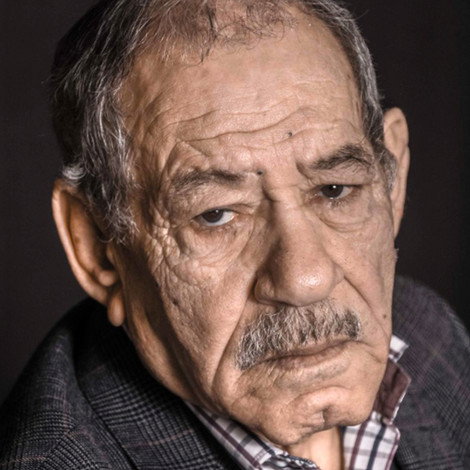
Personal Info
Known For
Gender
Birthday
Place of Birth
Ahmed Benaissa
Biography
Known for

The Arab
Haroun is an old bachelor who has lived in Oran for several years. A retired civil servant, he leads a reclusive life until the day he meets Kamel in a bar—a journalist to whom he tells an incredible story dating back to 1942. He claims to be the brother of ‘the Arab’ killed in a story told in one of the most famous novels of the 20th century, ‘The Stranger’ by Albert Camus. An Arab with an erased name: Moussa. Through anger, assertions, details, and confidences, Haroun finally convinces the journalist to listen to his story. His confession is a cry of freedom and distress—but above all, a cry of revolt: against an abusive mother, against a country that failed to achieve true independence, against a book, and against a famous French writer.

Sons of Ramses
Thirty-four year old Ramsès has established himself as a clairvoyant in La Goutte d’Or, Paris. A shrewd manipulator and something of a poet, he built a sound business consoling people. Elusive and dangerous youths, freshly arrived from the streets of Tangier, disrupt his business and the whole neighbourhood. Until the day Ramses has an actual vision.

Close Enemies
Driss and Manuel both grew up on the same council estate. An estate where the sense of belonging to your patch is much stronger than the sense of belonging to a country, a nation or a culture... Manuel has assimilated this belonging, and he has even benefited from it and built his life on it. Driss, meanwhile, has shunned it. They will both have to face up to the consequences of their decisions – because they will each have a price to pay…

Papicha
Nedjma, an 18-year-old student passionate about fashion design refuses to let the tragic events of the Algerian Civil War keep her from experiencing a normal life. As the social climate becomes more conservative, she rejects the new bans set by the radicals and decides to put on a fashion show.

Krim Belkacem
This film retraces the combat journey of Krim Belkacem, one of the leading figures of the Algerian War. When he left the Dellys barracks in October 1945, the day after the Second World War, Krim Belkacem was 23 years old. He is a man revolted by the May massacres in Sétif, Guelma, Kherrata and several other localities in the ravaged country. But it is also and above all a young Algerian who questions the future of Algeria. On March 21, 1947, Krim at the age of 25, he dug up his "Sten" submachine gun, he took action against the boss of his douar who was none other than his cousin. He goes into hiding with six companions. He meshes this entire part of Algeria with a dense and dense network with the sole objective of taking action which will lead to the outbreak of the armed struggle on November 1, 1954.

Ismael's Ghosts
Just as the disheveled and alcoholic filmmaker Ismaël embarks on a difficult new film project, his life is sent into a tailspin. His wife Carlotta, presumed dead for 20 years, come crashing back into his life creating chaos in his work and his current romantic relationship with the starry-eyed astronomer Sylvia.

La Tragédie du Roi Christophe

Wlad Lahlal
Marzaq and his brother Zeno search for their family after spending their childhood in an orphanage following the death of their mother and the imprisonment of their father. Fate wills that they meet their younger brother Elias and also their father, who confesses that he wronged their mother and falsely accused her of her bad behavior and murdered her.

Kahla wa Bayda
Rabie is a kid from Sétif in 1980, trying to collect money to buy a wheelchair for his paralyzid sister Sassia, so she can get out of the house.

Mista

Outside the Law
After losing their family home in Algeria in the 1920s, three brothers and their mother are scattered across the globe. Messaoud joins the French army fighting in Indochina; Abdelkader becomes a leader of the Algerian independence movement in France and Saïd moves to Paris to make his fortune in the shady clubs and boxing halls of Pigalle.

Habib
The story of a young Belgian actor of Moroccan origin who agrees to play the role of Saint-François-d'Assise to put an end to the roles of nice Arabs that are stuck on his forehead in often mediocre films. Getting into the historical figure will represent a real challenge for him; when his father, settled in Morocco, suddenly returns to Brussels with a new wife, and the beginnings of Alzheimer's, he finds himself having to juggle between the expectations of his colleagues and his family.

Rome Rather Than You
For more than ten years, Algeria has been living a slow war, a war without a front line but having caused more than 100,000 deaths. It is this desert that Zina and Kamel – two young Algerians, sometimes hallucinated and joyful, sometimes dejected and serene – will want to travel one last time before leaving it for elsewhere. A road movie on the territories of a city, Algiers whose construction sites are in decline. Roma wa la n'touma will show that fleeing abroad is not is not a refusal of combat, but an obscure struggle against assignment.

Morituri
In the civil war that tore apart Algeria in the 1990s, police chief Brahim Llob hunts down Islamist extremists on a daily basis. Having become the favorite target for them, it is with fear that he goes every morning to his office at the Central Commissariat of Algiers. Annoyed by the power in place, preparing to publish a whistle-blower book, Morituri, Llob is obliged to take early retirement.

Inland
Malek is a surveyor who is semi-retired, but at the urging of a friend he takes an assignment in western Algeria. The region in question was the site of frequent battles during the civil war, and an earlier survey that would make it possible to bring electrical utilities to the area was cut short by the fighting. While the zone is still unstable, Malek sets out to complete charting the area, and finds the locals regard him with suspicion and hostility.