
Personal Info
Known For
Gender
Birthday
Place of Birth
Erika Dannhoff
Biography
Known for

Michael Kramer

Demon of the Himalayas
German film about a Himalayan expedition and the search for a mountain spirit, who guarded, according to the tradition of the locals, the peaks of high mountains. The long-lost and recently rediscovered and restored film is now a unique cinematic document because it is the first feature film that was shot directly in the Himalayas (up to 6400 m altitude). Hans Ertl even turned his Bell & Howell to the main summit of Sia Kangri, 7422m. Likewise, the film contains footage from India and Tibet, from a time long before the emergence of mass tourism. Some of the footage was later recycled in ‘Lost horizon’ (1937) by Frank Capra and in ‘Storm over Tibet’ (1952).

Unendlich tief unten
Insurance clerk Paul Montag is assigned to investigate the death of Magdalene Gard. The 28-year-old sportswoman died in the middle of a tennis tournament under unclear circumstances - allegedly of heart failure. Shortly before her death, she had taken out a disproportionately high life insurance policy worth DM 100,000, which was not paid to her mother but to a mysterious organization called “Cumulus”...

Sacred Waters
For centuries, the water supply of a mountain village has depended on an endangered, wooden water pipe. The young engineer Josi blows a channel in the rock. After initial resistance, the villagers are excited about it. The film was based on a novel by Jakob Christoph Heer.

No Way Back
A Russian army officer is haunted by the memory of a girl he met during the war.

Anastasia: the Czar's Last Daughter
In 1920, an unknown 24-year-old woman was fished out of Berlin's Landwehr kanal after a suicide attempt. Since she has no papers and no answers to any questions, they soon assign them to the insane asylum Dallendorf. A co-patient believes she recognizes the Czar's daughter Anastasia Romanowa - who apparently was the only one who survived the murder of the tsar's family in 1918.

The Axe of Wandsbek
Hamburg, Germany 1934: An executioner is needed. Teetjen makes the biggest mistake of his life. Because his butcher shop is facing bankruptcy, he agrees to execute a group of political prisoners for the Nazis. Once this becomes known, Teetjen’s life falls apart.

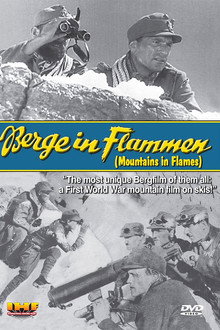
Mountains on Fire
Two of Germany's best and busiest directors collaborated on Berge in Flammen (Mountain in Flames). The storyline should be of interest to pro-ecologists, inasmuch as the directors take to task the warmongers of the world for despoiling the natural beauties of the European mountain ranges with their shell-fire. The final outrage occurs during a battle between the Austrians and the Italians in the Dolomites, culminating with the destruction of an entire mountain (hence the film's title). The harrowing images on screen were complemented perfectly by the musical score of Giuseppe Beece. Also known as The Doomed Batallion, Berge in Flammen was filmed in three different languages -- German, English, French -- for a total cost of $150,000.

The Rebel
A young medical student returns to his Tyrolean home to find out that Napoleon's troops have taken over the area and that his mother and sister have been murdered.

Der Mann mit dem Laubfrosch
An unknown guest checks into an obscure hotel. He is a burly but well-dressed gentleman carrying an umbrella and a tree frog in a glass. This man spends most of his time wandering the hallways and staircases of the inn, ostensibly to hunt for flies to feed his pet. But quite obviously, there is more to it than that: the man also listens at doors and peeks through their keyholes.

Wenn du einmal dein Herz verschenkst

The Cabbie's Song
Ferdinand Strödl is the regular coachman for the distinguished Max Jolander, who is constantly on the lookout for romantic adventures. Jolander regularly has Strödl drive him to his rendezvous, during which the coachman witnesses the suffering of many a jilted girl. At such times, Strödl acts as a fatherly friend to Jolander when the consequences of his escapades take on tragic proportions.