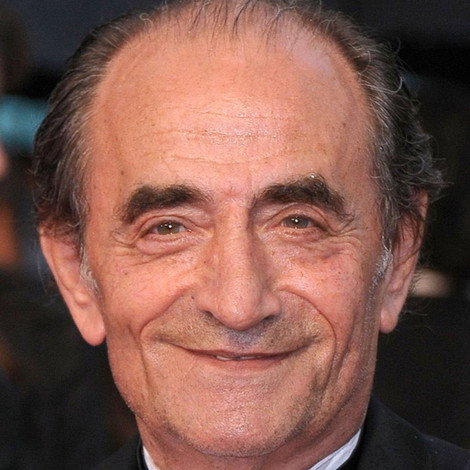
Richard Bohringer
Biography
Richard Bohringer is a French actor, singer, writer, and film director. He is the father of actresses Romane Bohringer and Lou Bohringer.
Bohringer was born in Moulins, Allier, France, to a French mother, Huguette Foucault and a German father. His parents met during World War II, making him a child of war.
At his birth, his parents left him with his maternal grandmother who lived in an HLM in Deuil-La Barre, his mother leaving to live in Germany. His father, dispatched to the Russian front, was taken prisoner for five years. Despite these difficulties, Bohringer describes his childhood with his grandmother as a happy one. During his life, he was able to see his father only three times.
He made his stage debut near the end of the 1960s. His first play, Les Girafes, was produced by Claude Lelouch. He entered the world of film with his first feature, Gérard Brach's La Maison, in 1970.
In 1972, Richard Bohringer landed a significant role in L'Italien des Roses. It took until the beginning of the 1980s, however, for the actor, already in his forties, to truly make an impact, becoming one of the most notable French actors of this period. Beginning in 1981 with the film Diva by Jean-Jacques Beineix, he followed with numerous other roles, winning two César Awards for L'Addition(1984) and The Grand Highway (1987).
Other notable performances include his work in Luc Besson's Subway (1985) and Gérard Jugnot's Une époque formidable... (1991). He also became a favored actor for Jean-Loup Hubert, playing the flighty husband in J'ai épousé une ombre (1983), and a collaborator with Jean-Pierre Mocky and his friend Bernard Giraudeau. In 1992, Bohringer and his daughter, Romane, were brought together on-screen by Claude Miller for The Accompanist.
In the 1990s, he became the presenter for Mission Appolo, a French-language variety show on Antenne 2, followed by the film Tango (1993), after which he worked more sparingly. Bohringer would then turn again to television with the series Un homme en colère (1997–2002).
Well before Bohringer began writing novels, he also attempted to write poetry set to music, himself a fan of slam poetry. He released a series of such albums between 1980 and 2002.
In 2010, at The European Theatre in Paris, France, he staged a one-man show adapted from his book Traîne pas sous la pluie. This began a tour of more than two years, with Bohringer regaling the public with stories of alcohol, travel, Africa, women, and more. In July 2011, he performed the show during The "Off" Festival of Avignon.
In January 2013, he created the play J'avais un beau ballon rouge, where he shared the stage with his daughter Romane for the first time. The play went on to great success on tour, and in Paris, at the Théâtre du Rond-Point.
A lover of literature, in April 2017, he read from the texts of Jack London and writer and war correspondent Olivier Weber during the opening night of festival of Literature and Journalism in Metz.
In 2018, he guest-starred in the television series À votre service.
In 2023, his daughter Romane put him onstage at the Théâtre de l'Atelier in Quinze rounds, a solo performance derived from his work of the same title.
Awards and recognition. ...
Source: Article "Richard Bohringer" from Wikipedia in English, licensed under CC-BY-SA.
Known for
Apostrophes
Apostrophes was a live, weekly, literary, prime-time, talk show on French television created and hosted by Bernard Pivot. It ran for fifteen years (724 episodes) from January 10, 1975, to June 22, 1990, and was one of the most watched shows on French television (around 6 million regular viewers). It was broadcast on Friday nights on the channel France 2 (which was called "Antenne 2" from 1975 to 1992). The hourlong show was devoted to books, authors and literature. The format varied between one-on-one interviews with a single author and open discussions between four or five authors.
Spécial cinéma
Marcello Mastroianni, Isabelle Adjani, Alain Delon, Martin Scorsese, Woody Allen... the biggest stars in cinema were welcomed by Christian Defaye on his show Spécial cinéma. Between intimate confessions from actors and immersion in the world of the greatest filmmakers, Christian Defaye took viewers on a journey into the fascinating world of cinema for nearly thirty years.
Numéro un
A French variety show.
On n'est pas couché
On n'est pas couché was a French talk show broadcast on France 2 on Saturdays at 11 p.m., hosted by Laurent Ruquier assisted by various columnists.
Cérémonie des César
The César Awards are cinematographic awards created in 1976 and presented annually in Paris to professionals of the 7th art in various categories to recognize the best French productions. They are often cited as the French equivalent of the Oscars in the United States.
Syndrome [E]
He is Franck Sharko, a crabby cop at the end of his rope. She is Lucie Henebelle, a lieutenant on the anti-crime squad obsessed with evil. Sharko and Lucie investigate top-secret scientific experiments and programs.
They Were Ten
Ten people, five women, five men, are invited to a luxury hotel on a deserted tropical island. They soon realize they are completely isolated, cut off from the rest of the word and all means of communication, which rapidly becomes their worst nightmare.
The Cook, the Thief, His Wife & Her Lover
When churlish mobster Albert Spica acquires an upscale French restaurant in London, he dines there nightly, effectively scaring off the clientele with his bad manners. His wife, Georgina, is especially disgusted by him, and soon begins an affair with regular guest Michael. Despite their best efforts to keep it secret, Spica learns about their trysts, and he plots a terrible revenge.