
Personal Info
Known For
Gender
Birthday
Place of Birth
Jochen Diestelmann
Known for

Polizeiruf 110
Polizeiruf 110 is a long-running German language detective television series. The first episode was broadcast 27 June 1971 in the German Democratic Republic, and after the dissolution of Fernsehen der DDR the series was picked up by ARD. It was originally created as a counterpart to the West German series Tatort, and quickly became a public favorite.

Five Cartridges
During the Spanish Civil War (1936-1939), five International Brigade soldiers of different nationalities are given a crucial assignment as their commander lies dying: they are to smuggle top-secret information across enemy lines.

Hallo, Taxi!
The story of a philanderer behind the wheel of a cab, who gets into a series of hilarious but also adventurous situations, was based on the actual experiences of Berlin cab drivers. It is an entertaining portrayal of how the main protagonist, Eddy, is to be cleverly dissuaded from his dashing bachelor life. Gaby and her grandpa come up with a few ideas. This is necessary, because Eddy may be a proper cab driver, but in his private life he knows no rules when it comes to winning over pretty girls.

Der Streit um den Sergeanten Grischa
Russian soldier Grisha escapes from a German prisoner-of-war camp in the spring of 1917. He is caught and is to be shot as a spy. This decision is controversial. The dispute continues. Grisha is executed on the orders of the army high command.

Fog
At the beginning of the 1960s, a German turns up on behalf of the NATO in the British village of Rocksmouth. NATO wants to establish a naval base in Rocksmouth, but first, the German envoy has to salvage an old ship wreck. In 1942, the "Princess of India" was supposed to bring children to safety in Canada but was sunk by a German submarine at departure. 58 people were killed, most of them children.

King Thrushbeard
A fairy-tale about a beautiful but very haughty princess Anna who cruelly mocks each of her suitors. Finally she is forced by the king to marry a beggar. The poor life, hard work and love teach the princess a lesson and turn her into a loving and kind person.

Decision Before Dawn
WWII is entering its last phase: Germany is in ruins, but does not yield. The US army lacks crucial knowledge about the German units operating on the opposite side of the Rhine, and decides to send two German prisoners to gather information. The scheme is risky: the Gestapo retains a terribly efficient network to identify and capture spies and deserters. Moreover, it is not clear that "Tiger", who does not mind any dirty work as long as the price is right, and war-weary "Happy", who might be easily betrayed by his feelings, are dependable agents. After Tiger and another American agent are successfully infiltrated, Happy is parachuted in Bavaria. His duty: find out the whereabouts of a powerful German armored unit moving towards the western front.

The Shield and the Sword
The year is 1940 and Nazi Germany is at the height of its military prowess, having captured most of Europe and eyeing the Soviet Union to the East. The Russian military command suspects hostile intent from Germany and so arranges for its spies to infiltrate ranks of the German military and the SS. Alexander Belov is a Russian spy, who travels from Soviet-held Latvia to Nazi Germany under an alias of Johann Weiss. His mastery of the German language, steel nerves and an ability to manipulate others help him to use his connections in the SS to ascend the ladder of the German intelligence. He uses his position to identify sympathetic Germans, who help him to procure vital intelligence, and to help local resistance movements in their collective fight against Nazism.

Flucht aus der Hölle
Algeria, mid-50s: it is the time of uprisings against the French colonial power. The German-born foreign legionary Hans Röder witnesses inhuman criminal actions against members of the Algerian resistance movement. These go to the account of the French secret organisation "Red Hand", but it cannot use witnesses. Röder deserts and tries to bring his observations to the public. He is relentlessly pursued by the "Red Hand", which leaves a bloody trace. Röder flees to West Germany, but here too the arm of the organisation enough. He sees no other way out than to escape to the GDR.

The Green Monster
On the run from police in America, Antonio Morena, a former World War II aviator and black-marketeer, finds himself in South America working for the all-powerful United Fruit Company, known to the natives as "the Green Monster".

Eva und Adam

My Zero Hour
Germany in 1943. The Berlin worker Klaus Hartung is deployed as a soldier to the Eastern front during World War II. During a tour, he is captured by a Russian patrol. While in captivity, Hartung comes to the conclusion that he has to come through and actively take part in the effort to end the war. He consents to abduct a German officer together with two Russian soldiers. During their adventurous mission, the men who at first had been enemies, become sincere friends.
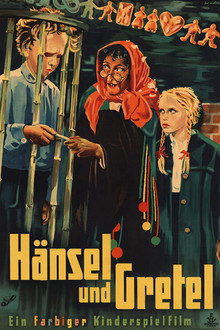
Hansel and Gretel
A Brothers Grimm fairy tale involving siblings finding a gingerbread house in the middle of the forest owned by an evil witch who captures them and by fattening them, intends to have them for her meal.

Standesamt - Eintritt frei
East Berlin, early 1970s: the funny, somewhat eccentric repair mechanic Roland and the cashier Christel quickly become a couple. After some back and forth, they get married and their first child is soon on the way. But the young couple's everyday life is not always free of conflict: Christel has taken an evening course to get ahead professionally, while Roland takes care of the child and household after work. Will their love withstand the strain? In "Standesamt - Eintritt frei", director Manfred Mosblech tells a subtle and cheerful everyday GDR story about two young people who are searching for the right path for themselves between professional life, friendships and marriage.

Thomas Müntzer
In 1523, young Thomas Müntzer arrives with his wife Ottilie in the Thuringian village Allstedt to assume the rectorate. As a follower of Luther′s teachings, he finds in the Bible not only reasons for clerical, but also for secular reforms. But when Luther turns away from the rural population after a discord with Müntzer, it is Müntzer who becomes the peoples′ spokesman. He is forced to go to Southern Germany, where he convenes with revolting farmers. But his way leads him back to Thuringia. In 1525, he and Heinrich Pfeiffer form the centre of the Thuringian peasant uprising in Mühlhausen, but their success is diminished by the fact that peasants and craftsmen don′t seem to be able to work together. In Frankenhausen, Müntzer becomes the leader of a peasants′ army that is set to fighting the ruler′s army – and sustains a devastating loss. Müntzer is arrested and sentenced to death by decapitation for his insurgency.