
Personal Info
Known For
Gender
Birthday
Place of Birth
Sylvia Pasquel
Biography
Known for

Conversando con Cristina Pacheco

Mi Destino Eres Tú
Mi destino eres tú is a 2000 Mexican telenovela. It is a production of Carla Estrada and the protagonists were Lucero and Jorge Salinas.

Top Chef VIP
Four finalists compete for the grand title of Top Chef VIP and a prize of $200,000.

The Poor, Rich Family
The Poor, Rich Family is a story of love, romance, twists of fate, and countless amusing situations involving two families with nothing in common—yet who are now forced to live under the same roof. On one side are the millionaire Ruizpalacios family; on the other, the Mendonças, a classic working-class family.

El Manantial
In the village of San Andres, the rivalry between two families the Valdes and the Ramirez is centered on "El Manantial", a beautiful fountain of water that happens to bathe the small property of the Valdes and not the neighboring ranch, the rich and prosperous hacienda "Piedras Grandes", where the best cattle are raised and is property of the Ramirez. But the spring is not the real reason for the hatred between the families. Justo Ramirez, married to Margarita Insunza, had a relationship with Francisca Rivero, wife of his enemy and neighbor Rigoberto Valdes. This relationship, founded in the betrayal, will cause the utmost bitterness and the destruction between the two families. The Valdes have a beautiful daughter named Alfonsina, who was born in the same year as Alejandro, the son and heir of the Ramirez. Although they have grown separately with their souls full of prejudices against their respective families, the two cannot avoid feeling attracted to each other. Margarita will not permit this and so she tells her husband to make sure her son will never be together with Alfonsina so he could marry Barbara, her cousin's daughter. Justo rapes Alfonsina and she leaves along with her mom and her aunt. Five years later... Alfonsina is graduating from school and has a good life until her mother commits suicide because she found out she was deathly ill and could no longer live with the guilt of her lifestyle. Before dying, her mother confesses to Alfonsina that Justo Ramirez destroyed her life and after that Alfonsina vows revenge on the man who destroyed her family. She returns to San Andres and there she once again sees Alejandro who is now engaged to Barbara. Their love is still present in their hearts. They will have to fight for their love and see if they can be happy by the shores of El Manantial... El Manantial is a Mexican telenovela that first aired in 2001, starring Adela Noriega and Mauricio Islas. The telenovela received TVyNovelas Award for Best Telenovela, in 2002.

Hurricane
Huracán is a Mexican telenovela shown in Mexico from October 13, 1997 to March 27, 1998, starring with the late Jorge Russek, Fernando Balzaretti, and Eduardo Palomo.
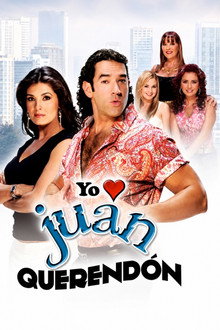
Yo amo a Juan Querendón
Yo Amo a Juan Querendón is a Mexican telenovela that aired on Univision at 7pm/6c for one year beginning in February 2007. The plot surrounded the story of Juan Dominguez and his interactions with the Cachon Family. The program was a remake of Pedro El Escamoso, a Colombian telenovela.
El amor nunca muere

Para toda la vida
Para toda la vida is a Mexican telenovela produced by Lucero Suárez and Juan Osorio for Televisa, in co-production with Megavisión, and originally broadcast on Canal de las Estrellas from April 15 to August 2, 1996. It is a remake of the 1985 telenovela Vivir un poco, which was itself based on the Chilean telenovela La madrastra by Arturo Moya Grau. The story follows Elena, a woman who is wrongfully convicted of murder during a trip to Chile. After spending fifteen years in prison, she returns to Mexico under a new identity to uncover who framed her, expose the truth behind the conspiracy that destroyed her life, and reunite with the family that believes she died years earlier.
Ha llegado una intrusa

Al rojo vivo

Días sin luna
Días sin luna is a 1990 Mexican telenovela produced by Juan Osorio and directed by Rafael Banquells based on an original script by Eric Vonn. It was aired in Canal de las Estrellas Monday to Friday at 17:00 between May 14 and August 31, 1990.

My Love, My Sin
Amarte es mi pecado is a Mexican telenovela produced by Ernesto Alonso for Televisa and originally broadcast on Canal de las Estrellas from January 5 to May 14, 2004. Created by Liliana Abud, with adaptation by Jaime García Estrada and Orlando Merino, the story follows Leonora Madrigal, a young woman whose life is marked by betrayal, sacrifice, and forbidden love. After being accused of a crime she did not commit, Leonora faces the consequences of a painful past while trying to rebuild her life and find happiness. The telenovela explores themes of love, revenge, ambition, and redemption.
Cuando los hijos se van

Alcanzar una estrella II
Eduardo invites young people from all over Mexico to join his new group, but at the last minute, Lorena shows up, and he decides to leave the group to accompany her on her world tour. It is then decided that the group will be formed without him; Jessica, Pablo, Marimar, Jorge, Silvana, and Miguel Angel are chosen to join, setting out in pursuit of fame and success as "Bonecos de Papel." The common struggles faced by these young people and the group's banter reflect this journey.