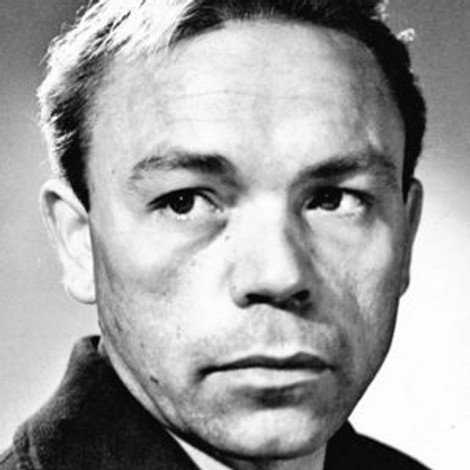
Personal Info
Known For
Gender
Birthday
Place of Birth
Vladimir Kashpur
Known for

Fuse
Fitil is a popular Soviet/Russian television satirical/comedy short film series which ran for about 500 episodes. Some of the episodes were aimed at children, and were called Фитилёк, Fitilyok, Little Fuse. Each issue contained from the few short segments: documentary, fictional and animated ones. Directed by various artists, including Leonid Gaidai who presented his famous trio of Nikulin, Vitsin and Morgunov into the cast. It was called in USSR as "the anecdotes from the Soviet government".

I, Shapovalov T.P.
The film traces the path of the hero (formerly an ensign and a Knight of St. George, and then a talented commander of the Red Army) from the Civil War to the Great Patriotic War.


Ono
The bureaucratic epos on the dialogues and plots of Mikhail Saltykov-Shchedrin "The History of a Town". In a metaphorical and grotesque form, the film conveys the history of Russia from the calling of the Varangians until the end of the 20th century. The film traces the change of the “chiefs” of the county town of Glupov, which differ in varying degrees of tyranny and the corresponding total number of “killed” city residents. The heads of the city easily guess the former heads of the Russian state and the USSR.

Rostov-Father
A stylish arrangement in a modern way of a number of classic love stories – "Carmen", "Orpheus and Eurydice", "Don Quixote", "Cyrano de Bergerac", "Hamlet". Each episode is a complete story with its own characters, they are united only by the place of action – the city of Rostov–on-Don. It is always summer here, women are beautiful and men are courageous, there is a high sky and a blue river, everyone is happy here or could be happy…

Siberia

Tycoon
During the Gorbachev years, Platon Makovski and his four buddies are university students who jump on the private capitalism movement. Fast-forward 20 years, Platon finds himself the richest man in Russia, having sacrificed his friends to get to the top. But with this cynical rise, comes a brutal fall.

The Love of Mankind
A film about young architects who are building a new city in Siberia (Norilsk), their anxieties, concerns, and victories. Story of subtle psychology of love and personal happiness experienced men and women, behind the shoulders of which the pain of the past

Shukshin's Stories
Each of the short stories is based on either one or several stories by a wonderful Russian writer. The heroes are ordinary people “of the people”, contemporaries of Shukshin, all of whose life’s ups and downs are inextricably linked with their country - the Soviet Union of the 60s-70s. The main thing that unites both the works themselves and the films made is a whole gallery of the brightest images and characters, a story about such different destinies and differently meaningful lives, a story in the center of which is invariably Man, with his love, quests, weaknesses and victories.

Russia Is Young
The Russian Empire, the turn of the 17th and 18th centuries, the era of Peter I's reforms. At the center of events are Captain Silvestr Ievlev, Lieutenant of the Customs Troops Afanasy Krykov, and Helmsman Ivan Ryabov. All three are very close to the emperor, who entrusts them with commanding the resistance against the Swedish fleet during the defense of Arkhangelsk. Each of the trio plays an important role in the defense of Arkhangelsk and the capture of the Swedish fleet.

Batallions Ask for Fire
A story of a several days of intense fighting on the Eastern Front during one of the Soviet offensives in WWII.