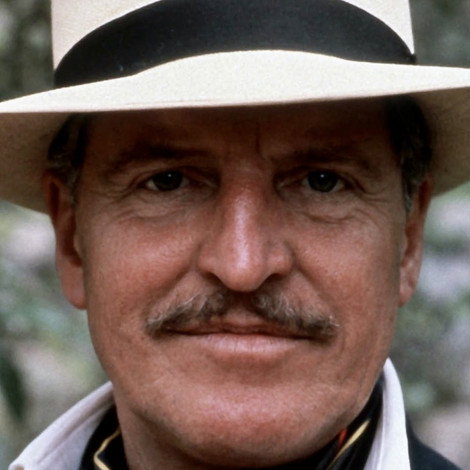
Personal Info
Known For
Gender
Birthday
Place of Birth
Denis Quilley
Biography
Known for

The Avengers
A quirky spy show of the adventures of eccentrically suave British Agent John Steed and his predominantly female partners. Jonathan Steed - an urbane, proper gentleman spy - teams with various assistants throughout the series' run, including Dr. David Keel, Cathy Gale, Emma Peel and Tara King, to repeatedly save the world from diabolical schemes plotted by equally diabolical evil-doers (among them robots and man-eating monsters).

Sherlock Holmes
Sherlock Holmes, along with his friend Dr. Watson, uses his abilities to take on cases by private clients and those that the Scotland Yard are unable to solve.

Tales of the Unexpected
A British television anthology of stories, often with sinister and wryly comedic undertones, and a twist at the end. With early episodes written and presented by Roald Dahl, the series featured a plethora of big name guest stars.

No Hiding Place
No Hiding Place is a British television series that was produced at Wembley Studios by Associated-Rediffusion for the ITV network between 16 September 1959 and 22 June 1967. It was the sequel to the series Murder Bag and Crime Sheet, all starring Raymond Francis as Detective Superintendent, later Detective Chief Superintendent Tom Lockhart.


ScreenPlay
Screenplay was a drama anthology television series, broadcast on BBC between 1986 and 1993. Numerous episodes were produced including one named "Boswell and Johnson's Tour of the Western Islands" starring Robbie Coltrane as English writer Samuel Johnson who in the autumn of 1773, visits the Hebrides off the north-west coast of Scotland. That episode was directed by John Byrne and co-starred John Sessions and Celia Imrie.

Dixon of Dock Green
Dixon of Dock Green was a BBC television series following the activities of police officers at a fictional Metropolitan Police station in the East End of London from 1955 to 1976. Some episodes were later remade as a BBC radio series in 2005 and 2006.

The Troubleshooters
The Troubleshooters is a British television series made by the BBC between 1965 and 1972, created by John Elliot. During its run, the series made the transition from black and white to colour transmissions. The series was based around an international oil company – the "Mogul" of the title. The first series was mostly concerned with the internal politics within the Mogul organisation, with episodes revolving around industrial espionage, internal fraud and negligence almost leading to an accident on a North Sea oil rig.

Churchill's People
Churchill's People is a British anthology series based on A History of the English-Speaking Peoples, Winston Churchill's four-volume history of Britain and its former colonies. 26 episodes were produced by the BBC and initially broadcast from 30 December 1974 to 23 June 1975.

Story Parade
Story Parade specialized in adaptations of modern novels. It was broadcast on June 5, 1964 and repeated on August 28, 1964. The teleplay was by Terry Nation (who invented "Blake's 7" and the Daleks in Dr. Who), and Elijah Baley was played by the late Peter Cushing. It also starred John Carson John Carson as R. Daneel Olivaw and Kenneth J. Warren. The master tapes of the program were erased, however a few clips from the production have turned up in various documentaries about Isaac Asimov's work.

Murder on the Orient Express
In 1935, when his train is stopped by deep snow, detective Hercule Poirot is called on to solve a murder that occurred in his car the night before.
Festival
An anthology of single plays offering up adaptations of either of prominent stage plays or novels.

The Return of Sherlock Holmes
In the second series of the widely celebrated ITV detective programme, Dr John Watson finds a mystery in an empty house, while Holmes and he later solve the mysteries of an abbey grange, the Musgrave ritual, a second stain, a man with a twisted lip, the priory school, and a half-dozen plaster busts of Bonaparte.

Masada
Masada is a 1981 American historical drama television miniseries aired on ABC under the tentpole ABC Novel for Television. The screenplay by Joel Oliansky is based on Ernest Gann's 1971 novel The Antagonists. A dramatization of the historical siege of the Masada citadel in Roman Palestine by legions of the Roman Empire in AD 73. A siege that ended when the Roman armies entered the fortress, only to discover the mass suicide by the Jewish defenders when defeat became imminent.

The Man in Room 17
The Man in Room 17 is a British television series which ran for two seasons in the mid-1960s, produced by the Northern ITV franchise, Granada Television. Key to the series' success was the involvement of writer/producer Robin Chapman. The show was set in Room 17 of the Department of Social Research, where former wartime agent-turned-criminologist Edwin Oldenshaw solved difficult police cases through theory and discussions with his assistants. The novelty of the series was that Oldenshaw and his colleagues never needed to leave their office in order to resolve cases, preferring to spend their time playing the Japanese board game of Go. They simply provided their prognosis and left the police to do the cleaning up. Different directors were often appointed to film the Room 17 and outside-world scenes independently, to maintain a sense of distance between the two worlds.