Personal Info
Known For
Gender
Birthday
Place of Birth
Alfred Neugebauer
Known for

Der Feldherrnhügel

High School
The love of a young Austrian aristocrat to a circus rider is put on a heavy load test when becomes obvious that the former officer has killed the brother of the young woman, a traitor of the country, in the duel.

Dreimal Hochzeit
Prince Alexander loves the commoner Vera and defies his uncle the Tzar as well as his peers by arranging his wedding. But Vera leaves him because she does not want to be the cause of him spending the rest of his life as a social outcast.

Viennese Girls
Begun in 1944/45, finished and released in 1949, this is a biography of the composer Carl Michael Ziehrer, who overcomes hypersensitivity in competitive situations which leads initially to failures in both career and romance.

Only a Comedian
A moving actor at the rococo era shows the power-hungry-crude minister of a small state prince in the barriers, while he makes use of his resemblance to the sovereign and slips in his role. - Double role for Rudolf Forster who plays his figures very much chilly.

13 Chairs
A classical art junk dealer and an almost bankrupt hairdresser who unexpectedly makes an inheritance go hunting behind thirteen chairs from which of a 100,000 DM contains which the rich aunt has hidden there.


Der Färber und sein Zwillingsbruder
Frühjahrsparade
This Hungarian musical comedy (English title: Spring Parade) was produced by Joseph Pasternak, who later remade the picture in Hollywood as a Deanna Durbin vehicle. The original 1934 version stars Franciska Gaal as a Hungarian serving girl who heads to Vienna to visit a relative. Stopping over at an outdoor carnival, Gaal is told by a fortune teller that she will enjoy a happy marriage with a handsome and wealthy stranger. Later on, she finds herself at a fancy dress ball, where a good-looking aristocrat, assuming that our heroine is a countess masquerading as a peasant, falls in love with her. Delighted that the fortune-teller's prophecy seems to be coming true, Gaal finds herself in a dilemma when she falls in love with poverty-stricken soldier Wolf Albach Retty. But things turn out OK when Retty, the regimental drummer, composes a hit song which brings him fame and fortune, thereby neatly fulfilling that prophecy.

Money on the Street
In this romance, a banker's daughter suddenly breaks off her engagement on her wedding day. She then meets a man who believes in easy money. He sees her as his meal ticket and the two take off together.

Der Verschwender

Schwarz auf weiß
Vienna, around 1900. The master baker Streussler’s most ardent wish is to see his daughter Nelly as a student at the university. With the help of his famous “streusel cake” he succeeds in luring all kinds of helpers for this endeavor into his house. But Nelly has entirely different plans: she is in love with the chimney sweep Heinz, the son of a neighbor, with whom Papa Streussler has been fighting for years. So it’s no wonder then, that the grump confectioner is doing everything he can to break up the relationship.
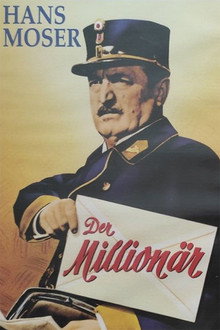
The Millionaire
Leopold Habernal, lives a quiet, modest life as a postman. When he unexpectedly inherits a large sum of money, he suddenly becomes an object of desire for several unmarried woman in the town, leading also to resentment amongst his former male friends. Ultimately he is able to use his money to benefit everyone.

The Heart Must Be Silent
On New Year's Eve 1900, Paul Holzgruber started a new praxis as a radiologist. The young Maximiliane Frey is his assistant and they have worked side by side for years helping people. Holzgruber repeatedly points out the dangers of radiation to Maximiliane, but is silent about the ulcers on his hand and the severe pain they have caused. Maximiliane has gotten to know the widower Axel von Bonin and has fallen in love with him. But then she is diagnosed with incurable cancer. To spare Axel the inevitable grief over her impending death, she leaves him and dedicates what is left her life to medicine.

Excursion into Life
Felix Bressart, later one of the most delightful members of the Ernst Lubitsch "stock company," plays the title character in the Austrian comedy Hirsekorn Greift Ein (Hirsekorn Does Something About It). It's a typical worm-turns affair, as a mild-mannered provincial actor ends up working as a chauffeur for a scatterbrained female novelist. Slapstick is the order of the day, except in the scenes involving heroine Charlotte Susa. Guiding the actors through their paces was Rudolf Bernauer, a stage actor-manager of vast experience. Critics in 1931 felt that Hirsekorn Greift Ein was too thin to be stretched to 90 minutes.