Personal Info
Known For
Gender
Birthday
Place of Birth
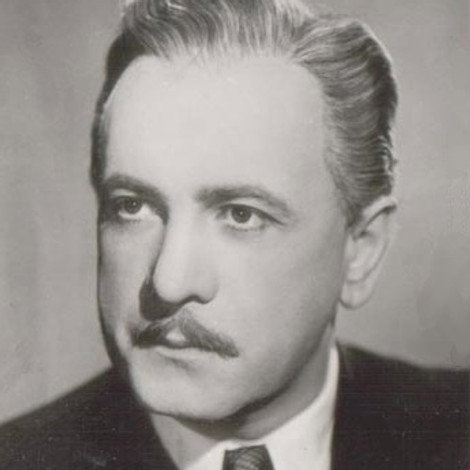
Andor Ajtay
Known for

Egy óra múlva itt vagyok…

One Bad Egg
The hero of the story, Gyuszi Ádám, the Jómadár, a lawyer's clerk in Pest, returns home to his parents in Kőhegy, and disrupts the stale, uneventful life of the small town with his mere appearance. He decides to revive his father's dying law firm and marry his 23-year-old sister, who is rapidly approaching the age of the "fair maiden". He successfully carries out his plans, tidies up the office and marries Sárika to their neighbour, with whom she has been hopelessly in love since she was a little girl. But in the meantime, she too falls into the trap of love...
In einer Stunde bin ich wieder da

Keresztúton
Fleeing Man
Sándor Vedres, a painter, learns that his success is not due to his talent, but to the intervention of his model, the flirtatious Marianne, and flees to the Transylvanian mountains with a disappointed heart and shaken self-confidence. His calm is disturbed by the appearance of Klara, who looks exactly like Marianne. His barely healed wounds are torn open by the encounter, he runs away upset and falls into an abyss. She is found unconscious. Marianne's sister, the noble-hearted Klára, carefully tends to the stricken man, who soon recovers but remains mute. The mute painter discovers pure love alongside the kind-hearted girl, and his paintings of the mountains are rewarded with a prize at the exhibition in the capital. News of his success attracts the old lover, but not the love of Klára and Sándor.

Penny
The story of a young servant girl who comes to work on the construction site of a large-scale industrial settlement. She decides to embark on an independent life, runs away from her foster parents, gets on a train and sets out to earn money. Modest and shy, she joins the factory's group of "Stakhanovites" and soon makes new comrades. Her coworkers accept her into their team.

Underground Colony
In 1948, when Hungarian industry counts on almost every liter of fuel, the production of Makert, an American oil company in Hungary, is declining by the day. The firm's American owners claim that the oil field is depleted. However, the new government controller, Nerges, discovers that this is sophisticated sabotage by which representatives of American industrial circles want to disrupt socialist construction in the country. With the help of Hungarian state security officers, Nergesz uncovers and neutralizes the saboteurs at the mine and hastens the Hungarian people's decision to nationalize Makert.

Two Confessions
This easy-to-take Hungarian drama is also known as Two Wishes. The prinicipal characters are a pair of juvenile delinquents, who may still be redeemable. The sullen duo is befriended by a kindly police inspector, who takes it upon himself to straighten out the boys. What follows cannot be termed surprsingly or innovative, though it is immensely satisfying. Of interest is the fact that a Communist-bloc film would admit to a delinquency problem in the so-called Worker's Paradise. Ket Vallomas was the Hungarian entry in the 1957 Cannes Film Festival.

The Day of Wrath
In May 1919 in a small rural town beside Salgótarján the local high society wants to get the power back with the leadership of dr. Máriáss, exploiting the outside attack launched against the Republic of Councils.

Catherine' Marriage
Kis Katalin and Varga Jóska are getting married. During their honeymoon they are preparing plans for the future. Katalin, however, seems to lag behind both in her studies and the work competition, becoming a couch potato version of a wife. Jóska, instead of trying to help, does nothing else than his work.

Kutyaszerencse

Silent Monastery
Count Vághelyi Gusztáv is now a member of the Carthusan order. He has to be there at her ex-sweetheart's, Betti's deathbed. Longing for penitence, he recalls his life so far.

Orient Express

Harlequin and Her Lover
Lint and his lover are sailing and making fun absent-mindedly at Lake Balaton when the anchor suddenly gets stuck in a bomb in the mud. Lint gets hurt while fussing about under the water. A strong storm breaks out when they reach the shore. In the local restaurant the man recalls his memories of war.

The Siege of Beszterce
The film evokes count Pongrácz, who, as late as the 19th century, managed to live a life, which reminds one of his medieval ancestor's values. He acts in defiance of the town by fighting his own battle against it, having been offended by the town.