Personal Info
Known For
Gender
Birthday
Place of Birth
Adam Baumann
Known for

Kryminalni
Kryminalni was a Polish crime drama television series that aired on TVN network from September 18, 2004 until May 24, 2008. It ran for 8 seasons and 101 episodes were broadcast in total. It was created by Polish director and screenwriter Piotr Wereśniak and produced by MTL Maxfilm studio. The series followed life and work of police officers from the elite Criminal Terror and Murders Division of the Warsaw Metropolitan Police; the title refers to police officers in the crime section. The three main characters were Adam Zawada, an experienced, tough cup, his younger colleague Marek Brodecki and Barbara Storosz, an ambitious female officer who in the first season joins the team just after graduating. Although none of the main actors had had star status before the series debuted, all three of them rose to prominence and popularity during the 5-year-long run. Many of Poland's best known actors guest starred, usually playing roles of people involved in just one particular investigation. The serial was one of the most popular in Poland: each week it had an audience of 4 million.

Blisko, coraz bliżej
The story stretches from 1863 to 1945. Its main characters are representatives of the Pasternik family, who live in the fictional village of Wielowice near Pszczyna. The protagonist of the first three episodes is Franciszek Pasternik, the following parts tell about the fate of his many children and even more grandchildren. The viewer follows their history against the backdrop of great changes and historical events that influenced the lives of Silesian Poles. So there is the Kulturkampf, Prussian rugi, the revolution of 1905, World War I and the Silesian Uprisings.

Provocateur
Warsaw, 1909. Arthur Herling makes an assassination attempt on a Russian police official and his family. During the action, the officer's daughter is killed and his wife is maimed. The wounded militant is arrested. Tormented by remorse, Herling agrees to cooperate with the tsarist authorities as a provocateur. Into his cell comes Adam Tanski, suspected of having contacts with the wanted conspirator Andrzej Woyda. One day, while being transported in a prison ambulance, Herling kills the guards. Accompanying him, Adam urges him to escape to the mountains.

Darmozjad polski
A slice of life type movie. A main plot goes around showing common behavior and psychological portraits of inhabitants of a typical little town in Poland.

Salad Days
World War II. The Germans enter Sosnowiec, which complicates the relationship between the three friendly children.
Sprawa osobista
Customs officer Andrzej Lechicki is arrested on charges of smuggling antiques. The defense of the accused is undertaken by attorney Sokor.

Znak Orła

The Sinful Life of Franciszek Buła
The end of the 1930s. Wilek Lizoń, a true-blue Silesian, together with his troupe of actors and circus performers, stages a play in the courtyards of miners' tenement houses. The main character is Franciszek Buła, a figure from folk tales. Buła's story begins during the Silesian Uprisings. The courtyard artists present vivid images of Frank's school years, his work in the mine, his communist activities, his imprisonment, and his constant poverty. Fantasy mixes with reality.
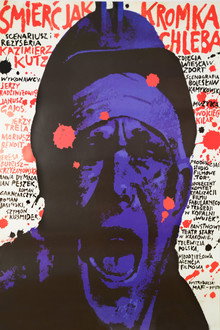
Death as a Slice of Bread
Katowice, the night of December 12-13, 1981. Military units occupy strategic points in the city. A group of Zomovniks, smashing union security, drags the chairman of the Company Commission of the NSZZ Solidarity in the Wujek mine out of his apartment. The news quickly spreads to the miners. Initially surprised, they soon react with spontaneous protest. On December 14, a strike breaks out at the plant. The miners demand the lifting of martial law and the release of the chairman. When negotiations fail, the army, ZOMO and militia storm the mine.

Angelus
A commune built around the pursuit of spiritual perfection through the occult begins to see its prophecies come true.

Soból i panna
A young landowner, Michal Rajecki, falls in love with a beautiful country girl, Warszulka, with reciprocity. During one of their trysts, Rajecki gives the girl hope for a future together. Eventually, however, he begins to realize that a misalliance would cost him too much. He follows his friend's advice and tells the girl to accept the proposal of the peasant who is trying to get her. When he begins to realize that he has made a mistake, it is too late.

Two of Us
An idealistic young cellist becomes dissatisfied with her relationship with a poor student who thinks primarily of money.

Death of a President
After Poland won freedom from of its long overlordship by Russia and the Austro-Hungarian Empire in 1918, it took a further four years for its National Assembly to elect Gabriel Narutowicz as its first president. Narutowicz was a professor who until his election had been living in Switzerland. Those were chaotic times, and shortly after his election, he was assassinated by right-wing fanatics. This epic Polish film chronicles the circumstances of Narutowicz's election and assassination.

Soccer Poker
Laguna was once a great soccer player whose career was interrupted by an injury. He spent years climbing the ranks to become an international referee. He sees the prevailing arrangements, manipulations, and bribery around him. Now desperate, he decides to stage an extraordinary culmination of his career: he wants to create a so-called "miracle Sunday" by "printing" the final round of games - taking substantial bribes from the interested clubs and manipulating the matches so that the results align in the order he set up.