
Personal Info
Known For
Gender
Birthday
Place of Birth
María Sorté
Biography
Known for

Burning for Revenge
Fuego en la sangre is a telenovela that began transmissions on January 21, 2008, through Mexico's Canal de las Estrellas network. Starring Adela Noriega, Eduardo Yáñez, Diana Bracho, and Guillermo García Cantú. It is the Mexican remake of the Colombian soap operas Las Aguas Mansas and Pasion de Gavilanes. The theme song called "Para Siempre" is sung by Vicente Fernández. The telenovela received TVyNovelas Award for Best Telenovela, in 2009.

Mujer de Madera
Mujer de Madera is a Mexican telenovela produced by Televisa in 2004. One unusual feature of this telenovela is that the main character is played by different actresses before and after her stay in hospital due to a forest fire.

Mi segunda madre
The story tells the story of Diana (Maria Sortè), a highly successful fashion designer married to an unreliable and lying man, Giacomo, and of Gianluca (Enrique Novi), a widower with a 10-year-old girl, Arianna. Diana, after discovering that Giacomo has another wife and two children, Davide and Chicco, abandons him, and leaves for a cruise with her friend Gloria. On the ship he meets Gianluca in the company of Viviana, who is actually staying with him for money. The meeting between Gianluca and Diana is one of those that are not forgotten and, what seemed only physical attraction, turns into true love. Diana is introduced by Gianluca to her daughter and immediately wins her sympathy.

The Tempest
La tempestad is a Mexican telenovela produced by Salvador Mejía Alejandre for Televisa. It is loosely based on the Colombian telenovela La Tormenta, produced by RTI Colombia for Telemundo and Caracol TV. William Levy and Ximena Navarrete star as the protagonists, while Iván Sanchez, Laura Carmine, Mariana Seoane, Cesar Evora, and Manuel Ojeda star as the antagonists. Daniela Romo is also confirmed to star. Previously, Jessica Coch and Adriana Louvier were originally confirmed to star as the antagonist.

Colorina

Curse by the Sea
Mar de Amor is a Spanish-language telenovela produced by Nathalie Lartilleux with protagonists Zuria Vega, Mario Cimarro and Mariana Seoane and antagonists Ninel Conde, Marcelo Córdoba and Manuel Landeta. This is a remake of the 1978 Venezuelan telenovela María del Mar.

El Privilegio de Amar
Juan de la Cruz, a young seminarian, visits the home of his mother, Ana Joaquina—a religious zealot who has always imposed her will on her son and instilled in him a calling to serve God. Working in Ana Joaquina’s household is Luciana, an innocent, dreamy young woman who falls in love with Juan de la Cruz. One night, swept up in the passion of youth, they give in to their feelings with tenderness and innocence. Upon discovering this, Ana Joaquina throws Luciana out; by then, Luciana is already pregnant with Juan de la Cruz’s child. When the time comes to give birth, she leaves her daughter at a stranger's doorstep, hoping the child will be raised there, but the baby is instead taken to an orphanage. To survive, Luciana becomes involved with a series of unsavory men—including Pedro Trujillo, a brutal man who beats and abuses her.

Mi Destino Eres Tú
Mi destino eres tú is a 2000 Mexican telenovela. It is a production of Carla Estrada and the protagonists were Lucero and Jorge Salinas.

Ask God For Forgiveness... Not Me
The story of Renata Flores del Angel, a young woman from a wealthy family who falls for Pablo Ramos, the foreman of her father's estate.

Paloma

La Verdad Oculta
La Verdad Oculta is a Mexican telenovela, fusion and remake of two telenovelas, one of which is El Camino Secreto; the other is Al Final del Arco Iris, a novela produced by Ernesto Alonso in 1982, written by María Zarattini and José Rendón. Probably because the telenovela is a fusion, there are two sets of protagonists: The actors playing the protagonists of La Verdad Oculta are Galilea Montijo, Gabriel Soto, Alejandra Barros and Eduardo Yáñez, and one of the antagonists is played by Julio Alemán. The telenovela was under the production of Emilio Larrosa. Mexico's Canal de las Estrellas aired the telenovela from February 27, 2006 to August 11, 2006. Univision aired it from August 31, 2010 to March 7, 2011 at 12am central. The story is distinctive in that three artifacts are practically characters in their own right and have their own stories: 1 a piece of paper with writing on it, 2 diamonds, and 3 a pair of cuff links. The story of these artifacts gets quite complicated.

DKDA: Sueños de juventud
DKDA: Sueños de juventud is a Mexican youth telenovela produced by Luis de Llano Macedo for Televisa and originally broadcast on Canal de las Estrellas from November 22, 1999, to April 28, 2000. Created by Susan Crowley and adapted by Sergio Schmucler and Carmen Sepúlveda, the telenovela stars Jan, Litzy (later replaced by Andrea Torre), María Sorté, Otto Sirgo, and Eugenia Cauduro. The series was conceived around a fictional pop group and blends music with teen drama. The story follows Rodrigo Arias and Laura Martínez, two teenagers brought together by the successful pop group DKDA. As they pursue their musical dreams, they face romance, rivalries, family conflicts, jealousy, and personal challenges. Alongside their friends and bandmates, they learn about love, friendship, loyalty, and the responsibilities that come with fame while navigating the ups and downs of youth.
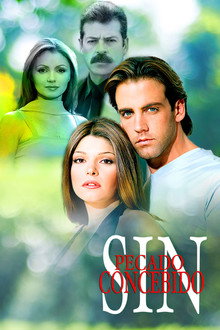
Sin pecado concebido
Adrián is the son of Claudio and Amparo Martorel, the owners of a perfume factory and the ranch "La Encantada", where Mariana also used to live when she was a little girl under Amparo's protection. However, a terrible event forces Mariana to leave the house and to enter a boarding school, while her brothers and father stay at the ranch. In the convent she meets mother Ángeles and sister Jovita, who along with father Gonzalo, become her spiritual advisors, and she thinks of becoming a nun. Five years later her father dies and she has to take care of her brothers, so she returns back to the ranch where again she meets Adrián, who has just returned back after getting his master degree in Chicago. Both discover that their adolescence love is still alive, but Adrián is now engaged with the ambitious Raquel, who will not stop at anything to separate them.

Killer Women
Mujeres Asesinas is a series that shows the dark side of women who have been mistreated or abused and become cruel murderers. The series shows how violence and death can overcome the feminine mind.

Entre el amor y el odio
A lonely and serious man finds in the death of his uncle, the love of his life and also the hate that may spread in his world.