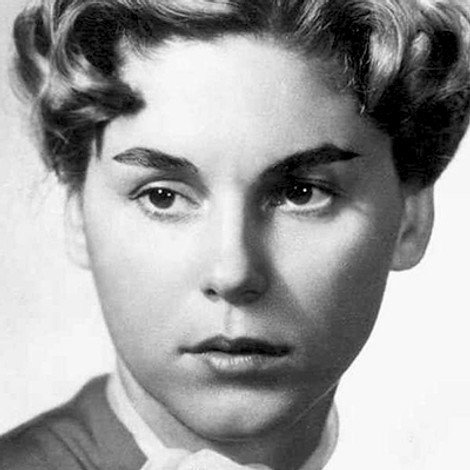
Personal Info
Known For
Gender
Birthday
Place of Birth
Emilia Radeva
Known for

Cerise
Cerise is fourteen years old but she looks twenty. Cerise grew up on the outskirts, but now she's exiled to Ukraine. Cerise wears excessive amounts of makeup, but she still has a little girl's dreams. Cerise doesn't know her father, even though she's going to have to live with him. Cerise has only ever thought about herself and now she finds herself in the middle of a revolution.

Home for Our Children

We Were Young
In 1940s wartime Bulgaria, a group of young student resistance fighters operate a secret printing press to distribute underground anti-fascist propaganda, while two members of the cell develop a romance that is continuously threatened by the surrounding political violence.

Life Flows Slowly By...
The fortunes of a group of partisans after the triumph of the socialist revolution.

Adam's Rib
The young Bulgarian Muslim woman Zyulker wants to study and become a teacher. Her father decides to arrange a marriage to her. After the wedding, she runs away and goes to the town. There she starts work in a hostel. Her husband takes her back. He beats and humiliates her. She gives birth to her child prematurely, takes the baby and goes to the school for Muslim in the town. She has to surmount many difficulties. The young woman meets her first teacher Stefanov. The two fall in love. With his help, Zyulker finishes her study successfully and makes up her mind to return to her native village as a teacher. Stefanov follows her and proposes to her. The two embrace.

Pauper's Joy
Anthology film based on six short stories by writer Elin Pelin. At the end of a market day, Stoyan learns that after ten years of marriage he has a son. Leaving the inn with his wife Penka, they find a baby girl thrown into their cart. There is no end to the poor man's joy. She too will be raised. Drought kills the land and the people. Grandfather Korchan and Lazar Dabaka decide to build a windmill. Lazar and his bride are traveling by cart to visit their godparents. They spend an unforgettable night under the starry sky.

The Last Word
The seven women inmates in Poslednata Duma are imprisoned because they have been associated with partisans opposing the fascist puppet government of the German Nazis. Each of them has the power to save herself if she will betray the others, and each bravely refuses to do so, even though it means they all will die. Despite their grim situation, and the atrocities perpetuated on them as political prisoners, they manage to laugh, and even celebrate a festival.

Memories of the Twin Sister
A family evacuates to the Bulgarian countryside during World War II

Crystals
Natural minerals are found all over the world. They represent the wealth of the country they come from. This film conveys the beauty of minerals.

Matriarchy
The film belongs to the 'migration cycle' in the Bulgarian cinema. It is about the drama of a group of women who have been left alone in their 'female kingdom' - a village deserted by its entire men folk.

The Penleve Case
The three grotesque novels whose action takes place at different times of the recent past are united by a common thematic key – their protest against violence and militarism, expressed by means of a kind of absurd humor.

The Bandit
Sicily, 1865. Two peasants, Gramigna and his father are tricked by Baron Nardò and robbed of their field, which then the baron lets to Assunta, her daughter Gemma and her fiancé Ramarro. Determined to take revenge, Gramigna begins to hunt down Nardò's complicit mediators. Unbeknownst to Gramigna, Gemma, to escape her arranged marriage, goes after him. Love and violence will follow all till their desperate ends.

Vatanen's Hare
A reporter who's soon to receive the Journalist of the Year Award hits a young hare on his way home. He gets out of the car to see if it's ok, but the hare runs off deeper into the forest, taking him on adventure of self-discovery.

Daughter-in-Law
The rich villager Yuftalana discovers that someone has broken corn from the cornfield. By chance he sees the thief - a child of a poor man. Blinded by rage, Yuftalana kills him with a stone...
Village Correspondent
The poor and illiterate village worker Dimo is in love with his landlord's daughter and events take their course...